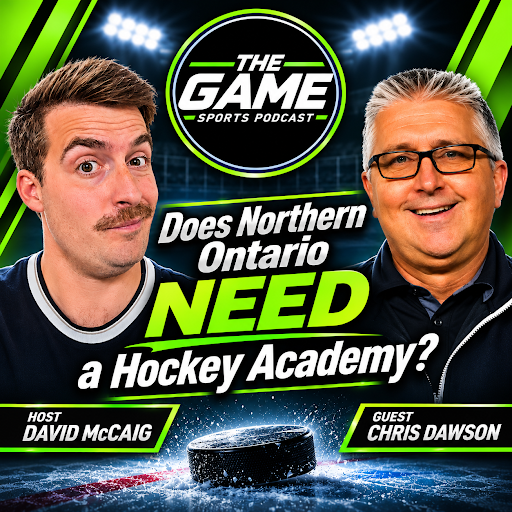
[00:00:04] Speaker A: Oh, yeah. And it's time for the Game Sports Podcast. It is Your host, David McCaig Jr. The game is a Studio 726 original series and featured on all platforms. YouTube, TikTok, Instagram, all the Game Sports Podcast. The Game has been around since 2016. We are in our 11th season, and this is another guest recording episode. We like to call them special edition episodes here on the Game. But before we get into introducing the guest, two things. Make sure again to remind you to hit like, follow, subscribe, interact on all the platforms of the Game. You make sure you don't want to miss this electrifying content.
And I got to do my guest introduction still that I always pride myself in. So sit back, pop that popcorn and buckle up for another great edition of the Game. And ladies and gentlemen, again, welcome back to an edition of the Game. But our guest today has spent more than two decades covering Northern Ontario sports, from the OHL North Bay Battalion to the story shaping junior hockey across the region. But he doesn't just report on the game, he's also involved in building it.
GM for the Powassan Voodoo is a junior hockey organization with Tyson North Bay Battalion. He brings a unique perspective from both sides of the game. He's witnessed the evolution of junior hockey, the rivalries, the development of young talent, and the changing pathways to professional and college hockey. Today, we're diving into one of the biggest questions in Northern Ontario sports as well. Who's actually producing the best hockey talent? Without further ado, welcome to the Game Sports podcast, Chris Dawson. Chris, thanks for coming by today. And in person, fun fact, done before you even say hi. This is probably unedique at all. I've done about 81 special edition episodes. Chris is the first one in person.
[00:01:49] Speaker B: There you go.
[00:01:50] Speaker A: First one in person. One of one. Yes. Or
[00:01:52] Speaker B: maybe one of many. Maybe. Yeah,
[00:01:54] Speaker A: that. That is that. Drive
[00:01:56] Speaker B: from North Bay and come sit next to Dave and have a chat about hockey and
[00:01:59] Speaker A: come meet. What's a
[00:02:00] Speaker B: better thing to do on a Saturday morning? Nothing
[00:02:02] Speaker A: better. Besides having a coffee and just, you know, hanging out and chatting sports, there's nothing better. And you know what I'll say. Granted, we didn't have a studio like this, you know, we've been recording, podcasting wise. But again, you'll be a trivia question forever on this show. Okay. And I'm proud that it's you, my friend. So welcome to the Sioux.
[00:02:18] Speaker B: Thank you. You
[00:02:18] Speaker A: know, welcome. I
[00:02:19] Speaker B: hear a lot. Yes. Wife's from the sue area, so a lot of connections.
[00:02:23] Speaker A: Now, before we get into topics and we're talking about this off air. I wanted just to dive into it right away your ties to the Sue. So obviously you know a lot of names, people that I've been and have had the pleasure of both playing with, against and with and beyond into men's league and whatnot. But mention some of those names that we would know.
[00:02:42] Speaker B: My, My wife's family billeted for a number of years. They had Jake Muzzin, probably the most high profile guy for a very short period of time and then Dylan King, Brett Finley for a short time too. And you're obviously a guy you're really familiar with. So Chris McKinnon, another high scorer that, that came, that came through the when I think Craig Kartsberg was the coach. So yeah. And back, back in the 2000s, back around that time I was working in TV freelance and I was doing work for the score and for, for a show called Rink Rat tv. So I remember interviewing Trevor Daly in his OHL draft year when he was you know, shining for the, for the Greyhounds and now There's Trevor Daly Jr. Not a defenseman, but a forward that's putting up very good numbers for, for a rookie in the ohl. So yeah, lots of fun stuff. Saw Jake Jake King as related through our family. Dylan King even closer. And so I know the Kings really well. Saw Jake sat with Jake when he went on the, in the. One of the first few Internet drafts back in the, in the, in the 2000s and, and saw him have to you know, wait and all the stories and you know, maybe Barry was going to take him and ended up going to the Sioux and having a real great OHL career. So yeah, a lot of great connections. Sue's a great hockey hockey community. So.
And when you talk about some of our things, it's pretty tough to, to. To look at another community than the Sioux in the north right now as the developing the most talent. So
[00:04:20] Speaker A: yeah, I know there's a lot there and I know that's our point but I like what we were chatting about off air. The other point of saying how the, how tough it is to, to go on and you know I, I was, I was happy when he came in and you said that we have, we have not like say direct history but you remembered who I was. Absolutely.
[00:04:35] Speaker B: Randy. Randy Russin used to talk about you a lot and you know, all the potential that you had and getting to, getting to greyhounds camp and you understanding, you know, how it's not easy, you know, and the hurdles Are getting thicker too. You know, you have the politics of not only you know who, who drafted you, where you're drafted, but you have, you know, the agents that, you know, powerful agents have A guy maybe isn't that good, he's going up against Dave McKaig and well, you know what we got to take. And
[00:05:07] Speaker A: truthfully,
[00:05:07] Speaker B: we're gonna take this guy. Not, you know, so
[00:05:09] Speaker A: I didn't have an agent. And to share a story I always give credit to, I call him my second father, Billy Conduro. He trained me when I was 13 years old. Get a nice time at the roads every morning, five days a week. It made me late for class all the time. I had 60 some lates in high school in one semester alone because I went late with the hockey excuse, thanks to my dad on that one, you know, but obviously I trained hard. Trained hard, trained hard. Went from double B hockey to A hockey to junior hockey, worked. And that Greyhound camp that you mentioned, it was a great moment and it was one of the best hockey I've ever played. But when I didn't make it where I thought I maybe had a chance to maybe sign there or maybe or be with the Thunderbirds after for an affiliate, that's what discouraged me a lot as a player. That's where when I didn't make it that year, I stopped caring about hockey. I just went into it for fun. I just wanted to play for fun. I just wanted to play out my junior career and not skate and work out anymore and didn't want to do that. Now looking back, is that one of my regrets? I don't like having regrets because it all worked out right in life. You know, I'm sitting here talking to you, so does go down a different path. But if I could change that, I probably would have changed my mentality and use that as motivation a little bit more. But when you're an 18 year old kid who you know, was really proud of himself and then gets put down and he couldn't face that adversity anymore. It was a challenge. So it's just, it's. Hockey can be cruel, Chris. Hockey could be cruel, but it depends how you come out of it. And I'll never forget, you know, the, the, the stuff Randy wrote and all the moments I had with the Beavers and the T Birds, the Eagles, you know, I played around the area. Randy had a name for me.
[00:06:39] Speaker B: Didn't you even go west? For a short time I
[00:06:41] Speaker A: did. I went to Thunder Bay. Was. That was probably one of the worst hockey experiences I'm not gonna lie that I've had out there, but I blame organization for that. I had a. Had an issue where I had a friend pass away in town and they told me I either had to come back instead of going to the funeral, I went to the funeral, which was the best decision. I will always. I spoke at that friend's funeral.
So, like, at the end of the day, my most fun that I've had was definitely in Blind River. The fans there were great. That's where I played most of my games in Junior were in bl.
But again, point to, the whole point of the conversation. I know we went down a little rabbit hole there, but hockey can be cruel. It can make you change what your mindset is, especially at a young age. Right. And that, that's where, you know, guys like Dylan Finner. Finner, Skype, perfect development story. Him and Colin Miller are two names that I will never forget here in Sault Ste. Marie for what they've done. But you can't, can't discredit what King has done. And even Brett Thompson. And you talk about Muzzin. I felt that Muzzin truck hit me in the Greyhound camp and it was an.
I don't know how I got up from it, to be honest with you, but it's. It could be cruel. It can make you change if you don't get what you want. It can really flip a player. But you talk about the Sioux, a lot of good players at that time, and it just be discouraging overall.
[00:07:57] Speaker B: Yeah, I mean, back at that time, yeah, I was coming to the Sioux and Sudbury because there was no OHL team in North Bay at the time, you know, and it really, really hurt the development.
There were just no North Bay kids in the, in the major. Junior, I think, you know, Matt Marquard, who's behind the bench with the Battalion, he ended up going a crazy path from a double double a midget to the CCHL and ended up playing in the Quebec League. And he was like the only player from North Bay playing major junior at the time. Whereas, you know, Sudbury and the Sioux, you know, both probably had five or six at the time, you know, so.
[00:08:36] Speaker A: And you were Temiskamine originally.
[00:08:40] Speaker B: My first kick at the cat, Steve McCharles got me as a scout and director of player development. And yeah, that was the first time I would have seen you play was the Timiskaming Royals playing the Blind River Beavers probably at Le Centre. And
[00:08:57] Speaker A: that was a great, cool experience to go play over at Timiskov and that's great. But now obviously things have transitioned and you've done great for yourselves. Congratulations on that. But the big thing is correct me if my research is wrong, but you also reached 400 career wins as a GM. Is that correct? It is, yes. January 25th. Is that true?
[00:09:17] Speaker B: I think so, yeah.
[00:09:18] Speaker A: Yeah. So fun little fact that I pointed out, everybody, we do a lot of research on this, on this show.
But before we get into that hockey debate, you spend, you spent years covering and working within it. How'd you get involved in Northern Ontario hockey?
[00:09:31] Speaker B: Well, I moved here from Dawson Creek BC in 96. I drove right through Sault Ste. Marie, probably right through Queen street, probably got lost at the time trying to move from Dawson Creek B.C. to North Bay in 1996 and ended up working at MCTV and covering the Centennials. And I remember, I think my first, first big name I saw would have been Joe Thornton in a preseason game and the Centennials playing at Memorial Gardens in North Bay. And you know, you know, obviously there's some change. People in Northern Ontario know how CTV has changed. And I ended up getting laid off. Came back and laid off again when they got rid of our, our news, the newscast out of, out of North Bay. And then I ended up getting into TV production. Always loved hockey and I got involved in a TV show called Rink Rat TV that was like a minor hockey show and did a lot of stuff in Sudbury and Sault Ste. Marie as I mentioned, off the top. And then I got involved here in the Sioux. Sioux Today was opening up a branch.
Its second branch was Bay Today and they were looking for a new sports director. They had a guy from the North Bay Nugget, Jerry Desormo who started and he wanted to retire. And they came, came at me to see if I would do it and it was only a part time thing, but that was back in 2004 and you know, fast forward now and I'm, I've been 10 years full time still sports editor, but do a lot of news is my priority. But yeah, so have seen a lot of, see a lot of highs and seen a lot of lows for sure
[00:11:16] Speaker A: now you know what, I, I know I mentioned this as a text about North Bay and whatnot, but we'll get into that after we had a hot topic that was, that had a lot of interaction online, but Northern Ontario. Okay, I want to go into a topic about who's producing the best talent. Okay, so we're sitting here in the sue, you're representing North Bay and we can't leave Sudbury out of this, obviously. Okay. But when it comes to. To developing hockey talent, and you could be biased, but who's actually doing the best job that you can see right now in Northern Ontario with hockey development,
[00:11:45] Speaker B: you know, it's really tricky because I think that there's so much pressure from the outside for all Northern Ontario players. And even in the Sioux, sue was always an area, maybe it was so. Such a long distance, the Sioux kids would stay longer. But you're seeing some of the best talent from the Sioux leaving. You know, you're seeing the best player in the north from Timmons. He went to Hill Academy. You know, you saw, you know, a lot of, you know, blondons from. From the Sioux went down and played it down in Pittsburgh at an academy. So I think the pressure.
It's really hard to say because we're almost gauging up to an age group because so many of them end up branching off. And, yeah, the roots are still in the Sioux, but, you know, maybe some of their primary training is being done in Toronto or Pittsburgh or Ottawa, you know, and that type of thing. So it's really hard to gauge it. But, I mean, from all my time here, I'd have to say the Sioux has done the best job out of. Out of the three. The three communities, I think. And I don't know what it is, if it's just the passion. I know sometimes it goes the other way that, you know, teams have a tough time in the Sioux because, you know, I think people want to do it one way. And, you know, sometimes, you know, I guess it happens in every community, but I think working together for a single goal, I think even overall. Even in the overall big picture of Ontario, there are so many different pathways. And, you know, I. I talked to a friend of mine from Randy Edmonds, who's works for Cortex, and he. He does a lot of stuff in Sweden, and he just talks about. We, you know, I. I do. I'll give my plug here. I have a goalie podcast called Goalie Resiliency. And I said, why are. Why are European goalies doing so. So much better than Canadian? It
[00:13:43] Speaker A: is. And it's noticeably.
[00:13:44] Speaker B: He says, well, you know what? They'll start off in a club, and they'll play in that club up until their junior and maybe minor pro, and they'll have just two or three voices. And I think obviously this goes, like, no more about goaltending, but I think that the voices that all these families get in Ontario, I think it's pretty overwhelming. Yeah. And I think in some ways it probably hurts the development because there are so many different voices, so many different pathways to go that, you know, maybe if it was a little bit simpler like it is, you know, even you look at Manchester United, even the way they run soccer and you know, in, in England, you know, it's just club, the club team. You start with the club team and you go with it all the way through. And you know, sometimes you do need another voice, but sometimes those mixed messaging, I've, I've heard it from goalies. Well, my one goalie coach wants me to do this, but I, I should do it that way. And then the player ends up struggling.
[00:14:41] Speaker A: They do. And the big thing you mentioned and I, I'll be. To be honest, I felt during the age groups that were 91, so that's me up until 1999 was the Sue's big pivotal point. That's where you could have had a double A team made from the Triple A team. And that's where when the Sioux was going to tournaments they were always successful. I felt Sudbury was always there too. And I think North Bay I think was catching up at that time or was behind. But then the Sioux had a drop off, did have a slight drop off where I felt Sudbury, North Bay were ahead. But I think the Suez finally went to a direction that has got them back on track because they're getting people in the right places and bringing in the right individuals. I think that's what makes it successful. But there's always a deterior with pillion hockey in the Sioux. Now that is a big common one and I'm sure it might be in North Bay and I'm not too sure both Sudbury fully. But I'm assuming is the price is, is the cost.
You. You know, I have, I've had some hockey parents come up to me and I would love to do some rink interaction with fans to get real candid responses. But they want their son or kid to play not in the U15 or U. They want them to play the house league so they develop confidence. They're looking at more of that social perspective. And the kids aren't necessarily caring about playing at the higher levels. But I think that culture is starting to shift a little bit. But it's. I think cost is always a deter for the right players. But then when you've talked about players that have left to go to these academies, this might be a hot take. I don't want to take away from the sue, but I don't think that's a bad idea because I think Sault Ste. Marie, if you have an option to go to Detroit, if you have an option to go to Pittsburgh, obviously Detroit and Honeybeck and all that always have great programs and all that, but I feel that that's being explored because they're taking that step seriously and they're going to expand their horizons and there's more exposure.
But back in the day, the Sioux was just known and was always poor. People traveled to see which the Sioux needs to get back to. But I don't know if that's too hot of a take, but I think, you know, people leaving isn't a bad idea if the fit is right because sometimes other programs might offer more exposure.
[00:16:50] Speaker B: Yeah, I've always, I've said this and I know that North Bay was looking at trying to get Everest Academy started in, in North Bay, that, you know, maybe getting an academy program, a high profile one. I know there's some smaller ones right now in, in the north out of, mainly out of high schools. But I maybe if there was something like that that, you know, maybe could blend in with the sports school programming and maybe blend in with the great North U18 league like they do in the US where high school and AAA both are blended. Yeah, maybe you might see, you know, some better results and maybe less kids leaving.
[00:17:29] Speaker A: I think so. And this is what gets to, to my point that I wanted to make sure I touched on. Here are the communities competing against each other for talent when maybe they should be working together. That's kind of ties into that point. And what you mentioned a few moments ago about, we talked about development and all that. So do you feel that there's an opportunity that we can work together as three different communities?
[00:17:51] Speaker B: The one problem with hockey is, and I don't, I don't think I'm shocking, there's a lot of egos in hockey. Right. So to, to, you know, bend and be flexible is not. It's sometimes harder than
[00:18:05] Speaker A: it is,
[00:18:06] Speaker B: you know, and that's really a challenge. But you know, we all want what's, everybody should want, what's best for the team, not just for their team, for their individual player or, or, or their organization. But you know, I mean, it makes it tough to now with open borders where, you know, sue can go take kids from North Bay, North Bay can take kids from Sudbury, Sudbury can take kids from Timmons, Timmins can take kids from the Sioux. You know, so it's really, it's, it's really tough and certainly it is, it would be easy to say work together better would work but it's, it's sometimes easier said than done.
[00:18:45] Speaker A: It is. And I feel like I had a fun question I was going to ask you. I was going to say that obviously you're in the sue and I was going to give you a chance to explain why North Bay deserves to be in the conversation of the Sioux. Just have a little fun rivalry piece. But I can't say that with a straight face because I think the Sioux, like I was just saying a few moments ago, is still trying to get back to what it was and is in. There's been players leaving that have been drafted high up in the OHL and then have taken those experiences to Southern Ontario and as you mentioned, Blonde going over to the, to Pittsburgh and that. So it's, it's, it's hard to make that joke. I wanted to, but I feel that the development. I'll flip it around. How do you feel about North Bay's development? How do you think that
[00:19:25] Speaker B: it's improved immensely? I mean, you know, I don't disrespect anybody and I used to be on the Trappers Triple A board so I know a lot of the hard working folks on there and I think they're going in the right direction. I certainly in the last 10, you know, I mean, gosh, it's over 10 years, almost 15 years that the battalion have been in North Bay since 2013. So it's changed a lot. It's changed dramatically. Adam Dennis has done a, a fantastic job and I know they're, Chris Bartch is involved with another program to try to bring another skills program into, into North Bay. So it is, it is, it is improving.
I just find that it's just that some of the, it's almost, now AAA is almost becoming like a junior team where we don't need to focus on, we can take guys from everywhere else. I'd like to see more of a focus on more, more local players and, and try to develop local players instead of a fourth line, third, third liner from, you know, New Liskert or Timmons. Whereas you could take a North Bay kid who might not be as good but you take that North Bay kid over because you know he's part of your development. You want to develop your, the local kids, you
[00:20:41] Speaker A: want to focus on that local development in the community because that's also what's going to increase from a future perspective. Right? Maybe they have a brother, maybe they have a younger sister. Whatever the case may be, it's going to, word of Mouth. Right. If you have more of a local driven team and have that mentality, it might entice people to maybe play more hockey. I know it's an odd way of looking at it, but if they see that you're a team, taking players from elsewhere might discourage tryouts. It might discourage, though, the want to play.
[00:21:07] Speaker B: Yeah,
[00:21:08] Speaker A: right. For
[00:21:08] Speaker B: sure.
[00:21:08] Speaker A: And the big thing, NCAA and Ryder Cali. Okay, so you're the one who brought up Ryder for the reminder. I'm going to make sure that I stress on here that Chris is the one who told me to make sure we talk about Ryder. I didn't. I missed that. Obviously a big, A big piece. But you, you've been following the NCAA eligibility and the changes closely since 2024 is what I have listed down here. But how significant are the changes for the future of the OHL and junior hockey with all this NCAA eligibility?
[00:21:38] Speaker B: Oh, it's, it's, it's huge. It's completely changed. It's changed the landscape completely.
Adam Dennis, I thought, kind of got in front of it a little bit. Even before Ryder Cali.
He, he acquired the rights for Adam Fantilli.
Trying to get Adam Fantilli. Adam Fantilli grew up, played with.
For under John Winstanley who's now in Barry, but was back. Was still with the, with the Battalion, but they were trying to get Adam Fantilli to, you know, decide to play major junior, but he didn't want to because he, he had that commit from Michigan. Right. So imagine Adam Fantilli in the ohl, you know,
[00:22:18] Speaker A: dismantled it. Yeah.
[00:22:19] Speaker B: Yeah. So I think he got ahead of it in the fact that the announcement wasn't made, but he made. Adam Dennis made that big trade to get Ryder Cali from the, from the Sioux after he had committed to go to Harvard, which ironically he ended up decommitting to as he's in Providence now. Yeah. But yeah, I mean, was certainly a.
The timing was great. It, you know, made Adam look brilliant to be able to bring a player of that caliber in. Yeah. The only problem is now is you just see how quickly they're leaving. I don't know if the major junior teams realized how, how quickly some of these players would be leaving for school. Now when you look at a guy like in my perspective at least from Gavin McKenna. Gavin McKenna was 17.
Gavin McKenna wins a WHL championship. He had over 130 points. Unreal. And then going into his draft year, he goes to jump 10. Penn State.
[00:23:16] Speaker A: Yeah.
[00:23:17] Speaker B: Which to me was kind of wow. But he's Basically won, done everything he can aside from winning a Memorial cup with the Medicine Hat Tigers. So that is a player that I think. Yeah, you know I, I could see that it's fair. He's a, he's an elite talent generation generational
[00:23:34] Speaker A: you could say. Yeah,
[00:23:36] Speaker B: yeah. But Ryder Cali didn't even have a point a game last year. And no disrespect to Ryder, he's a great player drafted by the Florida Panthers. But instead of coming back one more year here as an 18 year old, he's gone to Providence this year, you know, so I'm not a big fan of that. I'd like to see, I'd like to see the working relationship work better where we a few more 18 year olds would aren't leaving as quickly for. For major junior as they are. I get it with the 20 year olds, you know and there's some new rulings now where eligibility ends up becoming an issue if you play out your 20th and you're not going to school.
So I get it why a lot of the 20 year olds are gone early. But yeah, I'd like to see that change and a few more 18 year olds because everybody's talking right now that the OHL and CHL hockey in general is becoming more of a younger league.
[00:24:33] Speaker A: I was actually going to say the changing relationship between junior A major junior and college hockey, it's changed. That landscape has changed. And what that landscape has come the age that you're watching because by 19, 20 especially certain players than some are looking at that jumping that ship to the NCAA ranks. Right. In particular you mentioned Gavin McKenna.
Different. I think it's a different example. I, I agree with that step but I'm a firm believer that you, if you're 16, 17 and you start your OHL career, get that under you get the get your bearings and spend two years or till you're about 19 then go over. Now if you're a generational Connor McDavid, you don't. You can ignore that point because you're going to be playing the NHL by the time you're 18. So you got to mature as quick as you can. I think college hockey gives you a different maturity than the Ontario Hockey League or the Q or the W does just because of the ages you play with and the structure of the game being a lot different. So I think that helped Gavin in his development. But somebody like you said, Ryder, maybe there was an opportunity to come back and wait to do that because I don't think he's going to be in the NHL in the next couple years.
[00:25:36] Speaker B: The other thing is you think, oh, you know, this is great. This is going to open up more doors for, for more Ontario kids. Well, the fact is a lot of the players that are leaving are getting replaced by guys from the USHL now too. I think, I think the, I read recently, I believe the Calgary Hitman. I know that obviously we're not, we're a long way from Calgary in the Sioux, but yeah, I believe they have 10Americans on their roster this year, which is great. Which is a number they're
[00:26:03] Speaker A: developing I never would have thought states right now.
[00:26:05] Speaker B: What's that?
[00:26:05] Speaker A: They're developing really well in the States too. Right.
So the big thing is do you think the OHL will ultimately become stronger because of this or are teams going to continue to keep their struggle. Sorry, are they going to struggle to keep their best players?
[00:26:18] Speaker B: I think it's an evolution. I think now looking forward to say okay, well we're on a four year plan. I think now your four year plan is becoming a lot more familiar to kind of like junior A hockey where you're almost recruiting every year for, for players for free agents and you know, because you are losing your good players at such a young age. So I, I think there's an evolution where I think the, the window of your window of, of trying to build something is probably a two year window instead of a three or four year window now.
[00:26:50] Speaker A: That's right. And that's where if let's say I'm a 16 year old kid, I'd love to go back to that. That would be, that'd be great. But if I was a 16 year old hockey player today.
Is the OHL still the obvious choice?
[00:27:02] Speaker B: I think so. I think for. I think there's even more of a. No question because of the fact that you know there isn't the, the issue with commitments and you know, so I mean we had one which I mean it's crazy. We like Alexander Sonier, second round pick of the Battalion. Just last week he was committed from. To Providence but he's not going till 2029 so. But 60. Yeah. I mean he wasn't going to do that just if he wasn't drafted into the ohl and that's right. So
[00:27:32] Speaker A: I'm a firm believer stay until at least you're 19 and then for your 19th maybe depending but your last year go over. Right. I think because you the maturity developing the O and in NCAA can shift and if you're a later developer you're not A generational talent. It doesn't matter what age you are anymore. If you're good enough, the NHL players can. You could still make the NHL at 23. You don't have to be 20. Okay. People develop. Look at these players that have come up late. Late bloomers. It happens that way. And it's also the best league in the world. So don't be hard on yourself. Absolutely right.
So how about we switch over to the Poisson Voodoos for a little bit? Okay. Obviously building a junior A organization.
So obviously like I said, you're the GM.
You have been the GM since it's founding in 2014. Yep. Correct. Okay. You were named that and I.
You got Your first no JHL championship 2016. 17 was the first year and that your GM of the year. Three times.
Just a flex for, for Chris to have. So I
[00:28:31] Speaker B: think all star. I don't think it was them. Two. Two times I've been the first team all star for. Okay. Yeah, yeah.
[00:28:36] Speaker A: And the gm. Okay. So now something people might not realize that you're not just covering hockey, you're running the junior organization. So since you've been with them since the beginning, what have you learned about building a successful hockey program? Because obviously you've had some good success.
[00:28:50] Speaker B: Well, I think honesty is a real like I had the real honor working for a number of years with Peter Goulet and you know, I think honesty and transparency is, is probably, you know, not always the easiest thing for, for teams to do, but you know, if you give a pathway to somebody and you, you are transparent about their opportunities, you know, I think that's, that's the least you could do.
[00:29:18] Speaker A: Yeah.
[00:29:18] Speaker B: You know, so you know, it was great working with Peter Peters within the OHL with Brantford now and a great hockey friend of mine. So yeah, I think that's, that's it. And you know, we got a young coach, Ty Prochyk, who's you know, very much the same way young coach, enthusiastic.
You know, we play at a high pace and you know, really enjoyed working with him. And we brought in Mark Gagnon who's my right hand man as my, you know, kind of sharing the GM role with, with, with Mark and he's, he's also our battalion liaison as he's a scout with the battalion. So working with Mark who used to be a coach with the voodoos back in 2017 when we won the championship. It's nice to, to have him and he's a Poisson guy and local. Yeah, it's great. And you know for the Northern kids. He's at the Big Nickel now. He's not on the road with a team like I am and he's watching talent and watching Northern talent and he's been part of Team nha. So, you know, I think we're really fortunate that, you know, with a guy like Mark, he's. He's got the pulse on all of Northern Ontario, you know, so we got lucky getting two. Two seasons ago. He's playing in the BC League now. But, you know, talking to Jeremy Stevenson, watching Dylan Roussel a couple years ago with the, with the Sioux U18 Greyhounds. Couple teams were interested, but I loved them.
[00:30:38] Speaker A: Yeah,
[00:30:38] Speaker B: you know, kind of like a Ryan Murphy, a guy you've had on a. On an episode. Offensive defenseman, kind of undersized, maybe not as appreciated, but we were able to get him to, to Battalion camp. And then this past year, Peter got him to Bulldogs camp, so. But yeah, I mean, keeping a pulse on the North. I think it's always easiest to recruit kids from the north because they're already here.
You know, sometimes in Toronto, players. We've had players from the US And Canada come up and they just don't like the small town feel. Some of them love it. Not all of them do.
[00:31:13] Speaker A: Not for everybody. And the homesick there is a homesick piece too,
[00:31:16] Speaker B: right? 100.
[00:31:17] Speaker A: And my point was going to be retaining and recruiting, but obviously that's a challenge in the role. Right. But you know, from your end. Two points that I'll combine here, recruiting and retaining. And then the next part is relationship with the North Bay Battalion. What do you. How's that. How does that work with your, with your realm, With Powassan,
[00:31:36] Speaker B: you know, known Adam for a long time and their goalie coach are. It's a really neat relationship we have. Trevor Wing is mentored by Nate McDonald, who is actually with Team Canada. Under 17 Team Canada's under 17 team. Nate is kind of mentoring Trevor. Nate won a championship as a goalie with us and now he's a goalie coach for the Battalion, but he's also working as our goalie coach. And we've got Owen Loftus, who's been shining at the U17 tournament for Team Canada, and obviously Alex Saulnier. So.
And then before that we've had Jax Pereira, who I think is going to really be a really special player, still finding his ground in the ohl, and then Cole Vrugdenhill was a goalie with them. So, yeah, it's been a great relationship. 10 Battalion draft picks. I talked To Adam the other day. 10 Battalion draft picks on the Voodoos this year. So we've had a really good, a really good relationship and we've even had a few more of those players that, that were able to get were free agent camp invites to Battalion camp that are on our roster as well.
[00:32:42] Speaker A: Yeah, that's, that's big thing developing through the system. The Battalion utilizing that a lot is very, very
[00:32:48] Speaker B: important. We've got a, we've got a. This year we've forged a relationship with Huntsville Junior C. So we have a Junior C sort of affiliation and we also work closely with the Trap Trappers AAA program. We have a lot of their players as affiliates. Have a few Junior C players as affiliates. So One of the U16 goalies is actually with us this week weekend because Owen Loftus is, is away with Team Canada. So we have a, a U16 goalie getting the feel, the, the feel of junior hockey on A three and three, the grind, the
[00:33:22] Speaker A: pipeline.
[00:33:24] Speaker B: It's great having all these relationships. I think, you know, makes things better. So
[00:33:29] Speaker A: it does. And I was, that was a big point about. Want to touch on was development piece and I want to touch on lastly, before we talk about the Northern Ontario Sports Academy, before we start transitioning to the conclusion of our segment. Time flies when you're having fun.
What do fans not understand about being a GM of a junior A hockey program?
[00:33:48] Speaker B: What don't they understand?
Probably the work, the paperwork, the phone calls, the emails, you know, so go grocery shopping with my, my lovely wife and put your phone away.
And then she sees me, you know, she's going to get something and she, she sees me in the corner.
No
[00:34:08] Speaker A: problem. I can talk.
[00:34:09] Speaker B: Yeah, yeah, yeah, exactly. You got it. So yeah, I think the time, the, the time and, and, and energy and, and you know what the, and the toughest part too, the, the, the that, you know, and we've had some movement this year too with, with our team. You know, having to, to tell a player he's traded or let go, like it tears at your heart. It's, it's the lousiest part of hockey.
So I mean you've probably said when you went to Greyhound Camp how you felt, you know, to know that, you know,
[00:34:38] Speaker A: and I've been traded a couple times. I know that conversation.
[00:34:41] Speaker B: I think my best story involving it was Tom McCarthy. I got to work with Tom, rest his soul, back with the Junior Trappers and I remember we were in July camp and Tom is tearing up and it was like the last day of, of our camp. And I said, said what, what's wrong, Tom? He goes, I'm gonna kill some kid's dream today.
You know, and, and that really, all that's really sat with me. And Tom wore his heart and sleeve and you know, I think I do too. It, it's the worst. There's, there's nothing worse, you know, because
[00:35:12] Speaker A: you work so hard and maybe.
[00:35:13] Speaker B: And it's not, it's not like, and a lot of times it's not like a job where you're the manager and you're bringing somebody in and they've, you know, been late for work or they. Performance management. Performance. Right. It's just about, you know, there's
[00:35:28] Speaker A: no room or, or do you have a team of other players who are ahead of them? Yeah. In the way. So that is performance management.
[00:35:34] Speaker B: Push them down.
[00:35:35] Speaker A: Exactly, exactly. Now let's shift to this, to the Sports Academy piece. I know we got about 10 minutes left on here, so the, this Sports Academy piece. So you mentioned something interesting before the show to me that I didn't research and see so, or talk about. But you believe Northern Ontario needs a hype and we kind of, kind of touched on the, touched on this a little bit at the beginning. But to officially say it, you believe that we need a high profile sports academy similar to what we're seeing in Southern Ontario. Why do you think that's necessary?
[00:36:04] Speaker B: I, I just think that it, it gives us a bit of a level playing field. I think it's something we don't have. Yeah. And I think it's all over. It's in Ottawa, it's in, you know, in the US it's in Pittsburgh, it's in Detroit, it's in, you know, it's, it's everywhere. And I think that, you know, it might be a good way to, to like, like I said, I always thought if there was a way to be able to blend a Sports Academy program with a.
Maybe you have two teams. Maybe you have a team that's sports school. Maybe you have a varsity team that's playing in the Great North U18 League.
[00:36:37] Speaker A: Yeah,
[00:36:38] Speaker B: something like that. And I mean I think the better players that the Northern kids play against will keep them here more so than if they keep seeing. I'm only allowed to, I'm only playing in the North. I'm only going to play four or five tournaments down in Toronto.
I don't think I'm speaking out of school for Sue Sudbury or Timmins or North Bay. I think the kids all want to play the best competition and I Think that's the best way. The best way to do it. And if you're playing good competition, it makes you better.
[00:37:13] Speaker A: So I know you mentioned kind of, you know, we talked about Everest. There was hill and all that. But if you were given the funding tomorrow, let's say I came to you Game sports podcast dollars.
Jokes aside, I'm
[00:37:26] Speaker B: sure we've went down. I. I've been down this road. We were. We tried. We tried to do an Everest Academy north in North Bay during COVID
[00:37:32] Speaker A: Yeah. If you had the money, where would you put it?
North Bay, Sudbury, or the Sioux?
And those are your three choices.
Can't go off the board and say Blind river or something like that,
[00:37:47] Speaker B: because hockey's political. I'm gonna say North Bay.
[00:37:50] Speaker A: Okay.
And you know what? North Bay is a little.
[00:37:54] Speaker B: We've got a new rink. We've got a new. There's a new.
There's a new Canadore Dome. The George Dirton. That's right. Dome that Canadore College has created. So I think there's a lot of opportunities there. Brand new twin pad.
[00:38:08] Speaker A: Yeah, good point. So,
[00:38:10] Speaker B: yeah, I think that. I think the sky's the limit. I know you. Obviously, the NCC is a new rink in. In the sue, but just for geography, it's a lot tougher to have it central. So
[00:38:21] Speaker A: that was my point, was geography
[00:38:23] Speaker B: Gateway of the North.
[00:38:24] Speaker A: Exactly, Exactly. So could.
Could we actually operate this?
Do you think it could be done? Obviously you believe in it.
[00:38:32] Speaker B: I think you'd have to work with people like the NHA and the OHF and some of the other hockey bodies. Hockey Canada. I certainly have to work with them. I mean, I'll be very blunt. The problem with the Everest north out of North Bay during COVID was that the school board backed out at the last minute. So the educational piece kind of fell out from underneath us. So
[00:38:57] Speaker A: see, and I.
[00:38:58] Speaker B: But that's also the same board that is being supervised by the ministry now. So I won't. I'll just leave it at that.
[00:39:04] Speaker A: Yep. Yeah. Won't dig into that too much, but, you know, I think. I think it would succeed. It doesn't matter where you put it. Sioux, North Bay, Sudbury, Blind River, Elliot Lake, New Lisker, whatever. Woodwork. It needs to be somewhere in a certain city, certain size, certain geography. You
[00:39:20] Speaker B: got to get the right. You got to get the right people. And
[00:39:22] Speaker A: that. That is the first part of it. The right people. And I won't get into that point. We're not here to attack or, you know, question or Anything like that. But we have to make sure the right minds are behind it. And I fully agree and support that. So now let's transition to the 20 plus years in hockey before we, before we conclude. So you've covered Northern Jer. Northern John, Ontario. That's a new, it's a new term. Northern Ontario Sports. For more than two decades you've been involved in the hockey operations. As we've talked about. What has been the biggest change that you've seen in junior hockey since that time? That's a lot. That's an open ended question.
[00:39:53] Speaker B: I, I think the speed and, and I, I think that you look back maybe 10 years ago at a, at a NHL game or an OHL game and you, and you look at a, whether it's an no JHL game. I think that, I think that the speed has, has, has increased immensely in the, and the talent and the skill and that that goes for a lot more of the training. I think, you know, a lot more is being put into hockey than it was maybe 10 years. There's more people investing more time, more, you know, more skills. You know, I know some people will say, you know, you got to take time off, away and, but I think the speed, I think certainly the speed, you know, watching it is, it's, it's increased dramatically.
[00:40:41] Speaker A: It has, it has now.
So give us a story from your career that people maybe haven't heard before.
So something that, from the press box behind the scenes that sticks with you. I know you shared a really good story about Tom. That, that was really nice. But besides, I guess, besides that story.
[00:40:55] Speaker B: Oh boy.
[00:40:58] Speaker A: No, pick one that first comes to mind.
[00:41:00] Speaker B: I don't know, I mean, I guess, I guess, you know, back in 2006, you know, hearing about Hockeyville and you know, getting a couple phone calls and talking to some people and we were doing a pond hockey tournament in, in, in North Bay and we ended up working with a lot of really good people, put a video together for, for Hockeyville and a few months later we were the second, second community to win Hockeyville back in 2006. And I can say it's what springboarded because into junior hockey because after Hockeyville I got a call from Steve McCharles from the Timiskaming Royal saying we, we wanted to, we need somebody to help, you know, you, you, you just helped North Bay as the chair of Hockeyville. So that's how I got Hockeyville kind of got me into junior hockey. That's a good story. Yes. See,
[00:41:58] Speaker A: that's cool. You know
[00:42:00] Speaker B: But I think I, I think the neatest part about it was our story behind winning was we had a pond hockey tournament where we brought through my hockey, through my hockey show. I had had some connections in the US and during Hurricane Katrina, I had done some stuff with the Baton Rouge, Louisiana minor hockey, and I'd found out that they had all their, a bunch of arenas were damaged or destroyed and hockey was still kind of evolving back in that portion of the U.S. so we decided to do a, a, a campaign to bring these, to bring a bunch of hockey players to our pawn hockey tournament. So we had this pawn hockey outreach program where we brought kids from Louisiana and Mississippi who lost homes or their rink was destroyed to play pond hockey. So we took that with a coach for food program which a dear friend of mine, Tom Heddeken, was running where he was, he was a, he was the, a goalie coach and a coach in Europe and he had kind of discovered Christabel Huey who was still playing in the NHL at the time. And he was, he was doing running practices and all the teams had to do during Christmas time was bring food. So he had this coach for food program. So, so it was us using hockey to help others from outside our community and us using hockey as a means to help those that are unfortunate. And I thought that that's really what hockey is all about to be help help your community and be able to use it to help help others who, who are deprived from playing on a beautiful pond in Northern Ontario.
[00:43:37] Speaker A: Now that is a story. Okay, everyone, everyone else is going to come on the show as a guest. Think of a story to top that. That's, that's a great memory to have now. So the future of Northern Ontario hockey is going to be my last question if we have time, a second one before we close. When you look at the next five or 10 years, are you optimistic about the hockey, the future of Hockey Northern?
[00:43:54] Speaker B: Yeah, you know what? There's a lot of really good coaches and I know there's a lot of really good young coaches. And you know what?
I would say this, and maybe here's my little testimonial looking at the camera. I, I really encourage if you love the game and you've played it at a, at a high level and you want to give back, there's nothing better than giving back to the game. And you know what? You have the knowledge if you're like, there's so many good young coaches that have played Triple A and Junior that are, that are coming out of the woodwork and young guys that are. That are really putting their heart and soul into it. And I just do it for the right reasons. Do it to help develop the kids. Don't do it for your ego. But those are the type of people we need. Like Max Reve is one for in North Bay right now, who's. Who's moving up the ladder. And he helps our team too. And we need a lot more guys like Max Reve and Ben Brunette and Reese Pru. All these young guys who went on to play junior hockey and now are coaching. That's what we need. We need these guys giving back.
It's more of a connection than an old, old fart like me that's, you know, 50 something talking to kids. That connection from those kids, those young men to the. To the young kids is so critical. I think
[00:45:05] Speaker A: it's huge. Definitely players that have played at the higher up. Give back to the communities. Now the last question. If you could change one thing about hockey development in north tomorrow, what would it be?
[00:45:16] Speaker B: I think breaking down barriers. I think there's a lot of rules, you know, that. That are holding things back.
I'd like to see the NOJHL and the great North U18 league work more collaborative. Collaboratively having a showcase where the Great north team has an all star during the NOJHL showcase.
Maybe even they work together as one group. The Great North U18 League under the blanket of the no JHL, you know, and helping promote the players, you know, on both. On both levels.
[00:45:51] Speaker A: Love that answer. Okay, so Chris, getting into the closing. Where can people find you? Where can people hear you? Where can people
[00:45:58] Speaker B: b. Ca. You can read my stuff on BayToday CA and anything about the Voodoos. You can follow the
[email protected] and our goalie podcast which we. My partner Rob Graham, we haven't done a few in a while, but that's goalie resiliency.
On. On YouTube you can find our. Some of our great episodes. Tom Heddeken is one of our. Has been one of our guests. So
[00:46:21] Speaker A: awesome. Check that out. See collaboration between the north happening here. Okay. This North Bay was in the Sioux and we have a guest upcoming too. And another addition from Sudbury who's known. I think Chris would probably know that individual that I mentioned. Yeah, everyone knows him too. But it's been a great conversation. I think you've given a great perspective on the. The development, the ideas and everything that you've done to the game. I'll say on behalf of not just the game. Sports podcast for coming by but the game in general giving back. We appreciate that because people like you that help keep not to streamline for kids but make the best out of the game, make people look forward to playing and are the heartbeat of the development of hockey. And you've done so much obviously with PUAs, so congratulations and all that. But thanks for coming by and taking the time my friend. It was great getting connected with you. Thank you. Just send an email sometimes to somebody people you get introduced and find ways to connect. So thanks again for coming by. It's been
[00:47:12] Speaker B: great pleasure.
[00:47:13] Speaker A: Awesome. This has been the Game Sports Podcast Special edition guest Chris Dawson. Make sure you're following all his platforms, especially the Game Sports Podcast, the Studio 726 Original Series, Tick Tock, Instagram, Facebook, YouTube, all at the Game Sports Podcast. Thank you again to Chris the team here at Studio 726. Until next time, I'm here to remind you to keep your stick on the ice. Swing your bats, catch your touchdown, strain your threes and shoot your shots. Booyah.